- Semiconductor BusinessHOME
- Products and Services of Macnica,Inc.
-
technical information

-
Events and Seminars
- Handling Manufacturer
- Support
- Inquiry
- Click here to purchase products
- Semiconductor business e-mail magazine registration


 Narrow down by specifying conditions
There are currently 2225 results.

The basic rule for power supplies for electrical circuits is to design the board carefully by using solid patterns to lower the impedance of the power supply and prevent voltage drops.
When incorporating the module into the system
In circuit board design, power can be supplied at low impedance using solid patterns. However, in final products and systems that are made by combining system power supplies, FA cameras, motors, etc., power is supplied by connecting cables.
In this case, the cable (wiring) may end up being long, which can result in high power supply impedance or large inductance.
Effect of long cable inductance
Unstable power supply (oscillation)
Thin and long cables and wiring have a large inductance component. If a large inductance is generated in the power supply cable, the power supply may become unstable (oscillation), so care must be taken.
For more details, please refer to [Power Supply Column] Part 1: Noise is coming from the DC/DC converter!
Possibility of overvoltage breakdown
If the inductance becomes large, not only will the power supply become unstable, but overvoltage will occur when the power is turned on, which may destroy the power supply of the system (on the board), so care must be taken. Please be careful with systems that frequently turn the power on and off (for example, turning the power on at the start of work and turning it off at the end of work).
For details on destruction caused by overvoltage, please refer to [Power Supply Column] Part 2: Is long wiring the culprit?
Effect of Long Cable Impedance
Complexity of system installation
For example, security cameras may be installed in locations far from the main system using long cables. Similarly, when building a manufacturing line in a factory, the control system and drive unit may be connected by long cables.
In that case, when supplying power with long cables, the power voltage is often fine-tuned using a volume control or similar device during installation. The quality of the power supply will depend on the experience of the operator performing the installation.
Environmental changes and aging deterioration
The power supply voltage value that was fine-tuned during installation may of course fluctuate due to environmental changes (temperature changes), deterioration over time, etc. Naturally, the initial value is set and checked during maintenance in anticipation of this, but this can be a worrying task, as it can leave you unsure whether the settings are correct or whether the maintenance frequency is appropriate.
Set voltage automatic adjustment solution
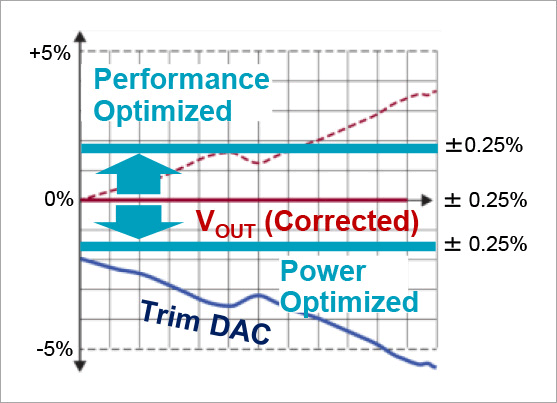
Analog Devices has a product called Power System Management (PSM) that can dynamically adjust the voltage accuracy to within ±0.5% of the set voltage.
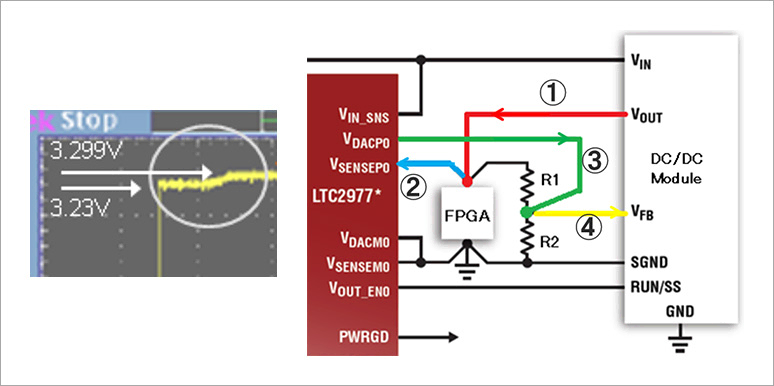
Suppose that ①VOUT of a DC/DC converter set to output 3.3V outputs 3.23V.
The PSM (LTC2977) reads ①VOUT as 3.23V on ②VSENSE line.
Because the output of the DC/DC converter is 0.07V lower, the PSM outputs an adjustment voltage to the VDAC line ③ to adjust the output of the DC/DC converter to 3.3V.
④By applying an adjustment voltage to the VFB line, the output of the DC/DC converter ①VOUT becomes 3.299V.
In systems equipped with this PSM, the output voltage is automatically adjusted if it varies with the connected load.
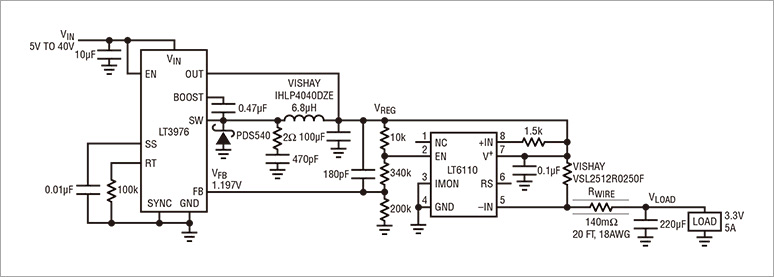
There is also a product called LT6110 that is specialized for compensating for cable drops. It is effective when the DC/DC converter (LT3976) and the load are connected via 20 feet of 18AWG copper wire, as shown in the circuit diagram below.
Use of the LT6110 dramatically improves load regulation characteristics.
For further details see design note DN529.
By using these products, it is now possible to automate all the voltage adjustments that previously required an operator to make manual voltage adjustments or to adjust the voltage values during regular inspections.
This reduces operator workload and improves the safety performance of the system.
Click here to purchase products
Recommended seminars/recommended articles/manufacturer site related links
Inquiry
If you have any questions regarding this article, please contact us below.
Analog Devices Manufacturer Information Top
Analog Devices Manufacturer Information If you would like to return to the top page, please click below.