- Semiconductor BusinessHOME
- Products and Services of Macnica,Inc.
-
technical information

-
Events and Seminars
- Handling Manufacturer
- Support
- Inquiry
- Click here to purchase products
- Semiconductor business e-mail magazine registration


 Narrow down by specifying conditions
現在2240件がヒットしています。check


Introduction
Hello. I'm Goo, who is currently in the middle of training.
The other day, I learned about "coils" during analog training (Fig. 1).
A coil is a tube-like structure in which a wire is wound around.
Some people may have used it in elementary school science experiments.
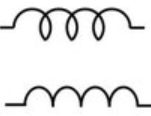
Figure 1: Coil symbols
I tried to summarize one question that came up while learning about such a relatively familiar component "coil".
By combining the coil with a power supply IC, the voltage can be increased (boosted) or decreased (stepped down) (voltage conversion).
An example of a boost circuit is shown below (Fig. 2).
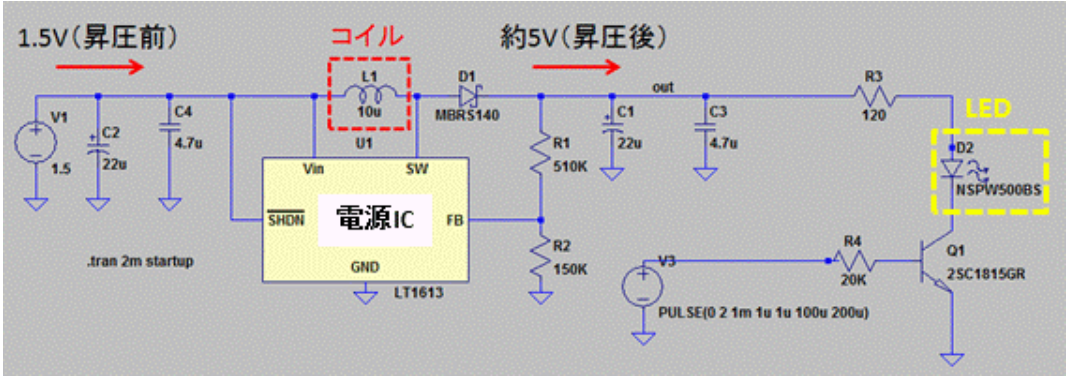
Figure 2: Boost circuit example
This circuit boosts the input voltage of 1.5 V to about 5 V, thereby lighting the LED.
(Pulse on the bottom right is an oscillator, which makes the LED blink.)
A question arises here.
"Increase the input voltage and output"... How is it possible to do such a thing?
Commentary
Coils have some peculiar properties.
1. If you try to pass electricity, don't let it pass.
2. When you stop passing electricity, it will try to pass more.
I will explain what this is all about using a diagram.
■ When trying to conduct electricity
The "coil" blocks the flow of electricity.
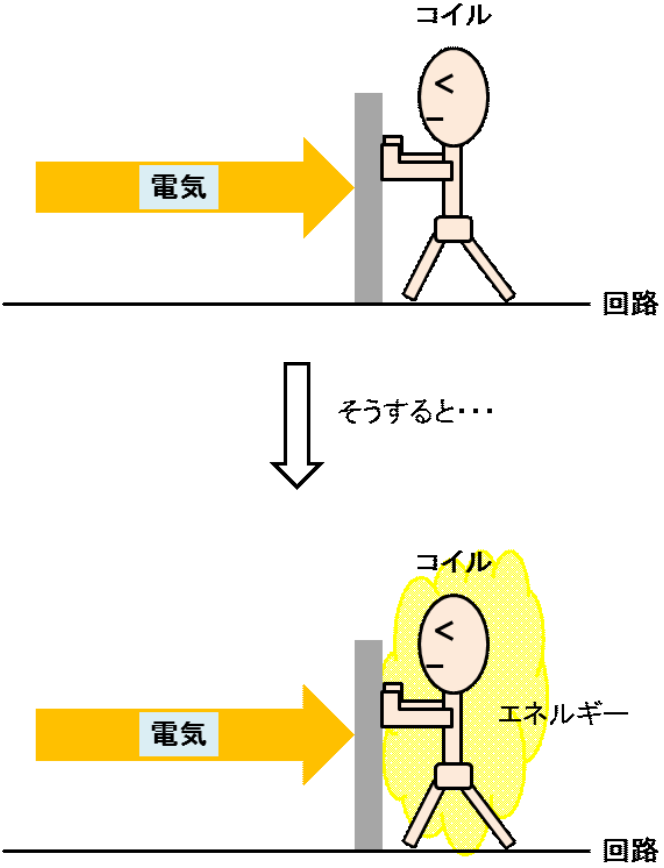
Energy accumulates in the coil.
■ When electricity is stopped
The coil will stop interfering with the flow and throw away the accumulated energy.
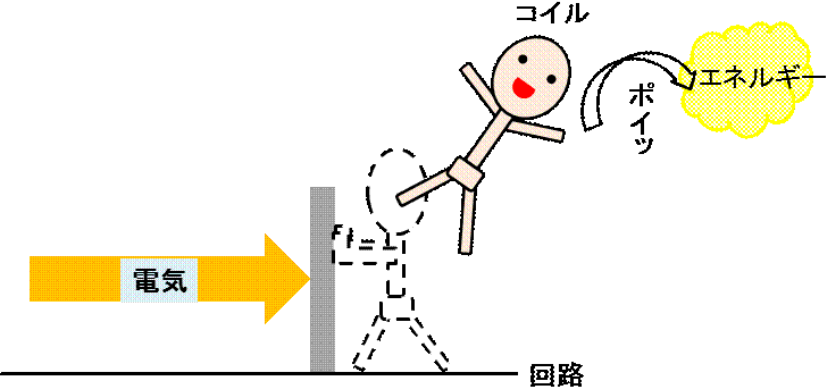
The energy that is thrown away at this time is not so large.
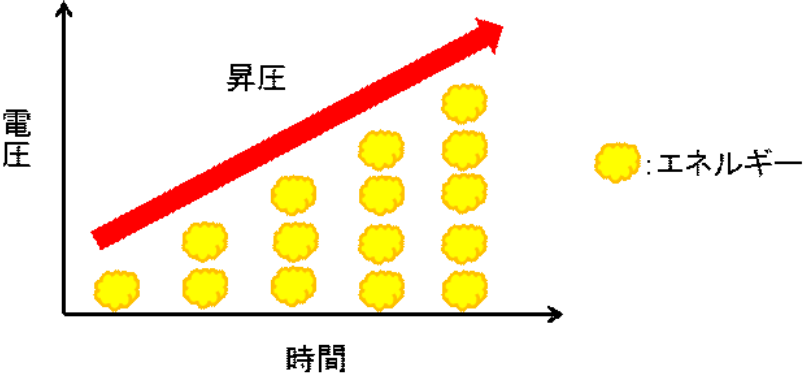
However, if you repeat this series of flows at high speed by turning the switch on and off,
As shown in the figure below, the voltage becomes higher and higher (boosted) over time.
It's just like "If dust piles up, it becomes a mountain"!
Summary
Due to the unusual nature of the coil, it is possible to increase the input voltage (boost it) and output it by turning the switch on and off at high speed!
■ guu's tweet
The booster circuit in Figure 2 is the board that I actually made in the training (Photo 1).
The wiring didn't go well and I shorted it many times ((+_+)).
But in the end I succeeded and was very happy when the voltage was actually boosted from 1.5 V to 5 V...
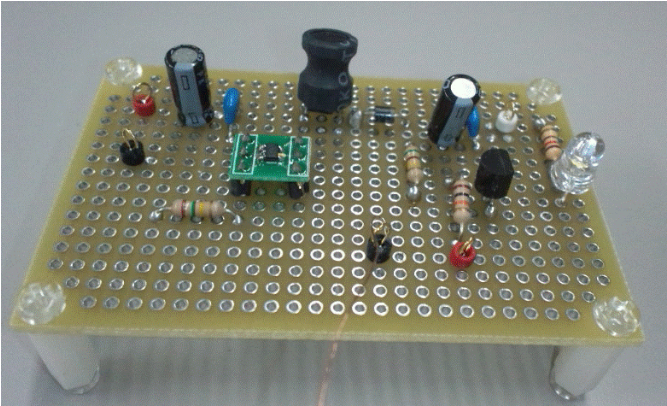
Photo 1: Booster circuit actually created
■ Check out the "Magic of Coils ~Boost~" series! !
Coil Magic ~Boost~
An easy-to-understand explanation of the principle of boosting using a coil!
● Continued! Magic of Coils ~Boost~
Is there a limit to boosting? Let's get to the bottom of the mystery!