- Semiconductor BusinessHOME
- Products and Services of Macnica,Inc.
-
technical information

-
Events and Seminars
- Handling Manufacturer
- Support
- Inquiry
- Click here to purchase products
- Semiconductor business e-mail magazine registration


 Narrow down by specifying conditions
現在2236件がヒットしています。check



Hello, I'm Mass Man.
This time, I will talk about when I stumbled on Verilog HDL syntax.
In the example sentences that came out during the training, there are two ways to describe the value assignment, and I got confused.
"a = b"
" a <= b "
Both mean "assign b to a".
If you look up what the difference is in the literature,
● Blocking assignment (=): Executed in order from the top within a sequential block
● Non-blocking assignment (<=): Within a sequential block, assignment can be made regardless of the order in which statements are written.
is explained.
A sequential block is the part enclosed by begin and end of the always statement.
I wondered, "What is the difference between the circuits that are actually synthesized?"
When I check the result with RTL Viewer,
Blocking assignment generated various circuits depending on the order of description.
The same circuit was generated regardless of the order of non-blocking assignments.
For blocking assignment (=)
|
always @ (posedge clk) begin dadb = da & db; dcdd = dcⅆ dout = dadb & dcdd; end end module |
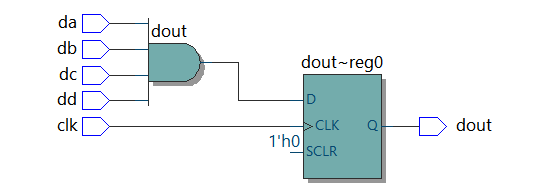 |
|
always @ (posedge clk) begin dcdd = dcⅆ dout = dadb & dcdd; dadb = da & db; end end module |
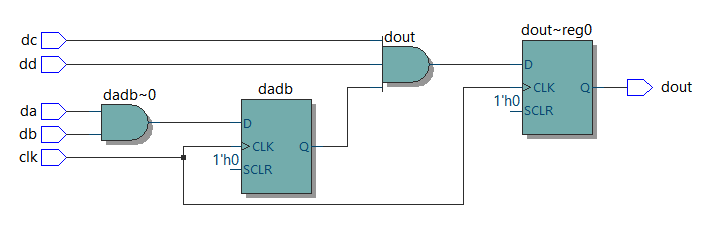 |
|
always @ (posedge clk) begin dout = dadb & dcdd; dadb = da & db; dcdd = dcⅆ end end module |
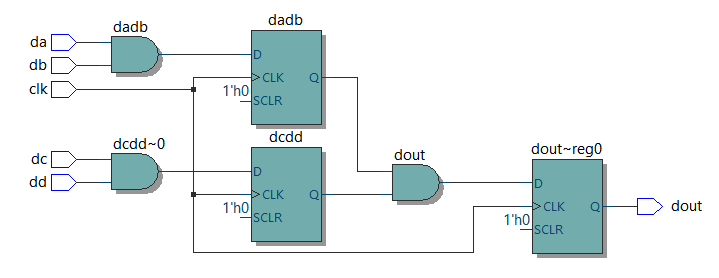 |
For non-blocking assignment (<=)
|
always @ (posedge clk) begin dadb <= da & db; dcdd <= dc & dd; dout <= dadb & dcdd; end end module |
|
|
always @ (posedge clk) begin dcdd <= dc & dd; dout <= dadb & dcdd; dadb <= da & db; end end module |
|
|
always @ (posedge clk) begin dout <= dadb & dcdd; dadb <= da & db; dcdd <= dc & dd; end end module |
|
what i learned
If you describe a blocking assignment in an always statement, a circuit that depends on the execution order will be generated.
If you look closely at the example sentences, the assign statement is written with blocking assignment (=), and the always statement is written with non-blocking assignment (<=).
I wrote a blocking assignment inside an always statement that created an unintended circuit and made me blush.