- Semiconductor BusinessHOME
- Products and Services of Macnica,Inc.
-
technical information

-
Events and Seminars
- Handling Manufacturer
- Support
- Inquiry
- Click here to purchase products
- Semiconductor business e-mail magazine registration


 Narrow down by specifying conditions
現在2207件がヒットしています。check


Hello, I'm Hachi. Last time, we studied about the time required for configuration. Until last time, I thought that once the power was turned on and the configuration was completed, it would enter user mode.
This time we will study one of them, Power On Reset (POR). Power On Reset Time is the time from when the power supply stabilizes to when configuration starts.
After turning on the power (in industry terms, it is said to turn on the fire. When I first heard it, I thought it was to incinerate the device. (laughs)) Time until the circuit assembled with FPGA starts working. I would like to follow and see.
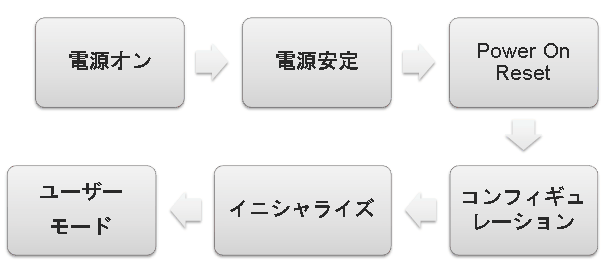
The FPGA is working through the steps shown in the figure below.
- power on
- Power stable: voltage reaches the specified value
- POR: Power On Reset
- configuration
- Initialize
- User mode
The time from turning on the power until the power stabilizes is specified as Ramp Time ( tRAMP ).
This is the time required to reach the specified voltage level from the start of voltage supply when supplying power from a power supply IC (regulator).
Power On Reset ( POR ) starts when the power is stabilized within Ramp Time. POR is literally the process of resetting the FPGA before starting configuration. Therefore, the sooner the power supply stabilizes, the sooner POR will start, and as a result, the sooner you can enter user mode.
Regarding POR, it was described in the following places.
configuration -> Configuration Requirements -> Power On Reset (POR) circuit
How are these times determined? Searching for "POR" in the datasheet yielded hits.
Data Sheet -> Recommended Operating Conditions -> table 1-4 -> Note (7), (8)

- Fast mode: about tPOR = 3ms to 9ms
- Standard mode: about tPOR = 50 to 200ms
Blush here again. Power On Reset time ( tPOR ) seems to include tRAMP. I got confused while writing the article, so the diagram shows the respective times.
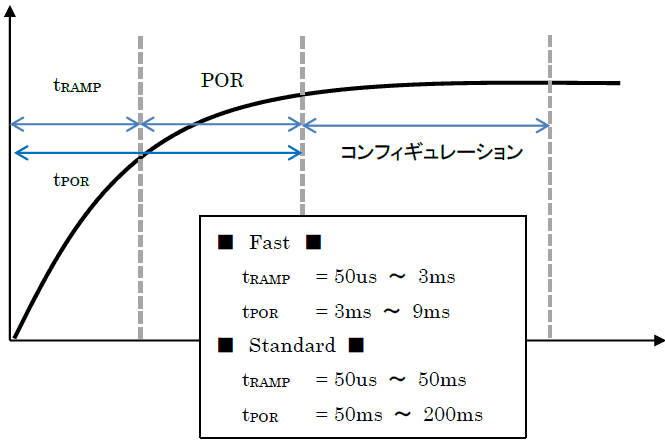
I see, looking at this, the time from turning on the power to entering user mode seems to be expressed by the following formula.
Time to enter user mode = Power On Reset Time + Configuration time + Initialization time
Note that tPOR and tRAMP change depending on whether the configuration mode is set to Fast Mode or Standard Mode.
In this AS configuration mode as well, you can select Fast / Standard Mode depending on how the MSEL[2..0] pins are handled.
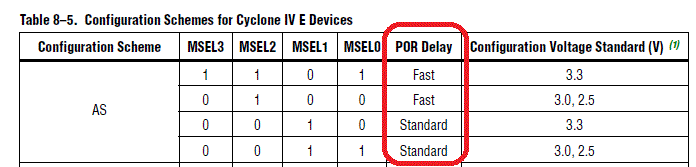
Here, the configuration time calculated last time is 147.2ms in the worst case, so if you add the tPOR time, you can calculate as follows.
(Click here for configuration time)
POR + configuration time = 200ms + 147.2ms = 346.2ms
After that, if you add the initialization time, you can see the time from turning on the power to entering user mode.
Next time, we will study about the initialization time.