- Semiconductor BusinessHOME
- Products and Services of Macnica,Inc.
-
technical information

-
Events and Seminars
- Handling Manufacturer
- Support
- Inquiry
- Click here to purchase products
- Semiconductor business e-mail magazine registration


 Narrow down by specifying conditions
現在2247件がヒットしています。check



Hello, I'm Guu.
This time, I summarized the questions that occurred when I measured the signal of the board I made in the training using an oscilloscope.
An oscilloscope is a device that detects changes in electrical signals over time as waveforms.
By using this, you will be able to see invisible electrical signals.
It's a convenient device.
One of the most useful functions when using an oscilloscope is the "trigger function".
"Trigger" literally means "pistol trigger".
It's a cool feature, but here's what happens when you use it.
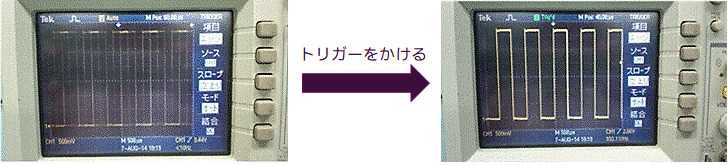
When you apply the trigger, the multiple overlapping waveforms become just one, giving you a clear view.
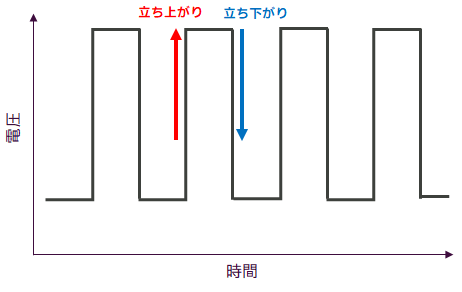
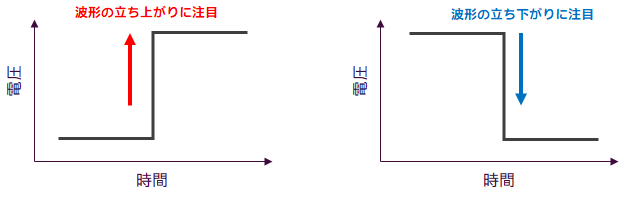
By doing this, you can check the rise and fall of the waveform.
I know triggers are useful, but what makes waveforms easier to see?
What exactly is the act of "triggering" in the first place?
Such questions have arisen.
Commentary
Looking at the screen of the oscilloscope, the vertical axis shows "voltage" and the horizontal axis shows "time".
When using the trigger function, the "trigger level" and "trigger position" are displayed as shown below.
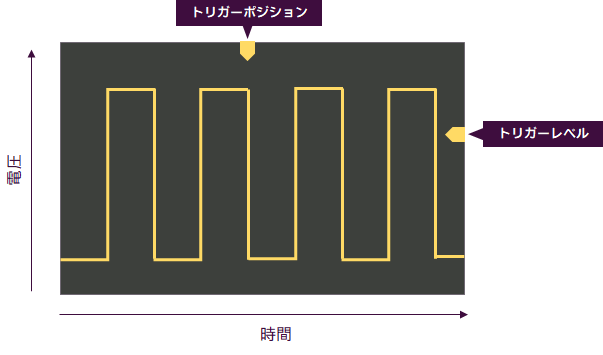
Trigger level indicates "voltage" and trigger position indicates "waveform display location".
Extracting only waveforms that pass the "set voltage (threshold)" at the trigger level is called "triggering".
By continuing to display only the triggered waveform, the waveform appears to have stopped.
In other words, it's like putting a trap in a certain place under certain conditions.
You can get prey (waveform) only when you get caught in a trap (trigger).
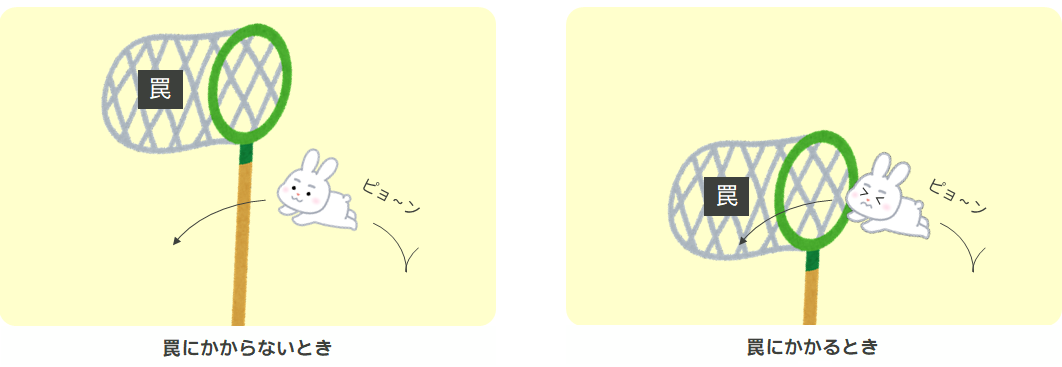
Also, by setting which part of the waveform (rising, falling, etc.) to apply the trigger to,
You can GET the waveforms you want to see (or know).
Summary
The trigger function is to set the location (trigger position) and voltage (trigger level).
A function that extracts only the waveform that passes through that point at that moment.
By changing the measurement conditions, you can obtain the waveform you want to see (or know).
Guu's tweet
The "trigger function" isn't just a cool name, it's a very useful function.
Let's do our best to master it!
bonus
I would like to introduce another useful feature of the oscilloscope.
That is the "waveform overlay function".
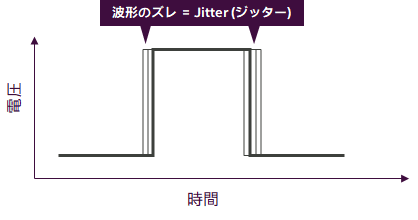
There is variation in the length of one cycle of the waveform, and when one cycle is 10 ns, it is sometimes 10.001 ns and sometimes 9.999 ns.
This variation is called "jitter".
The "waveform overlay function" is used to see how much Jitter is.
By superimposing the waveforms, you can clearly see the deviation in the period as shown in the figure below.