When it comes to developing motor application control, many engineers probably think of using a microcontroller.
However, when designing with a microcontroller, you will face the following challenges.
- Microcomputer discontinued for long-term product supply application
- I want to control multiple motors, but I don't have enough peripherals such as PWM on my microcontroller.
- Performance was insufficient when motor control and communication processing were performed simultaneously
These are some of the things you often hear in the development field.
However, these problems can be solved by using FPGAs.
We will also explain the advantages and disadvantages of using FPGAs.
3 Reasons to Use FPGAs for Motor Control
[Reason 1] Processing speed is overwhelmingly faster than microcomputers
Although the performance of general microcontrollers has improved, their processing speed is still measured in microseconds.
Even low-end FPGAs are capable of processing in nanoseconds, and their processing speed is overwhelmingly faster than that of microcontrollers.
Since FPGAs perform processing in hardware, they excel at processing PWM and other processes required for motor control.
This is because the difference is several times to over 100 times faster than the processing speed of microcontroller software.
[Reason 2] Multiple motors can be processed simultaneously
There are an increasing number of situations where 10 or 20 motors must be controlled in a single application, such as in industrial equipment or factory automation robots.
Is it possible for a single microcontroller to handle all of this processing? It would be impossible to control 10 motors simultaneously.
In the first place, there are no microcontrollers that are equipped with the dozens of PWMs required for control.
However, with an FPGA, it is easy to install dozens of PWMs. In addition, since a CPU can be installed inside the FPGA, it is possible to control dozens of motors with a single FPGA.
[Reason 3] Long-term supply is possible
The biggest concern for manufacturers supplying industrial equipment applications is discontinuation of products.
If a microcontroller is discontinued, in most cases it means that your company's products will also be discontinued.
Unless we are provided with a very reliable successor microcontroller, we will not be able to continue production.
Altera® provides most of its FPGAs for a long time. Some products are still in production more than 20 years after they were first manufactured. If an FPGA is discontinued, you can easily port your design source to a successor FPGA.
This means that the same functionality will continue to be available on future FPGAs.
That said, if controlling one motor is sufficient, a microcontroller will suffice, and there are also disadvantages to using an FPGA.
There are also disadvantages to using FPGAs
[Disadvantage 1] Requires multiple power supplies for operation
A typical FPGA has separate core and I/0 power supplies.
For example, an FPGA requires a 1.2V core power supply, plus an I/O power supply for each interface.
Multiple power supplies are required for each interface, such as memory, differential signals, and LVCMOS.
One disadvantage of FPGAs is that the power supply design is more complicated than that of microcontrollers.
However, Altera®'s latest device, the MAX® 10 series, is also available as an FPGA that operates on a single 3.3V supply, and this disadvantage is gradually being eliminated.
[Disadvantage 2] Configuration ROM required
Since typical FPGAs are designed based on SRAM, the circuit data inside the FPGA is lost when the power is turned off. Therefore, the FPGA needs to be configured from an external ROM every time it is started.
This means that the FPGA requires a two-chip configuration, and the external ROM also increases costs.
However, Altera's latest device, the MAX® 10 series, has built-in flash memory within the FPGA, enabling FPGA operation on a single chip, eliminating this disadvantage.
[Disadvantage 3] High unit price compared to microcomputers
A while ago, FPGAs were priced at several thousand to several tens of thousands of yen per unit, which meant that they were often several times more expensive than microcontrollers.
However, with the advancement of process miniaturization, low-cost FPGAs are becoming more common. Depending on the quantity purchased, it is now possible to purchase an FPGA for motor control for just a few dollars.
As mentioned above, there are some disadvantages to using FPGAs for motor control compared to microcontrollers, but the latest Altera® FPGAs have eliminated these disadvantages.
FPGAs are increasingly being used to develop high-value-added applications that require the control of multiple motors.
However, it is quite difficult to create and evaluate motor control from scratch using FPGA.
This is also true for microcontrollers, but it is quite difficult to suddenly develop a motor control circuit using an FPGA from scratch.
With a microcontroller, you can develop software to suit the peripherals, but with an FPGA, you develop it starting from the peripherals.
Therefore, the best way to develop an FPGA is to use a development kit or reference design.
Ready-to-use servo motor development kits "DE10 Lite" and "Servo Motor Kit"
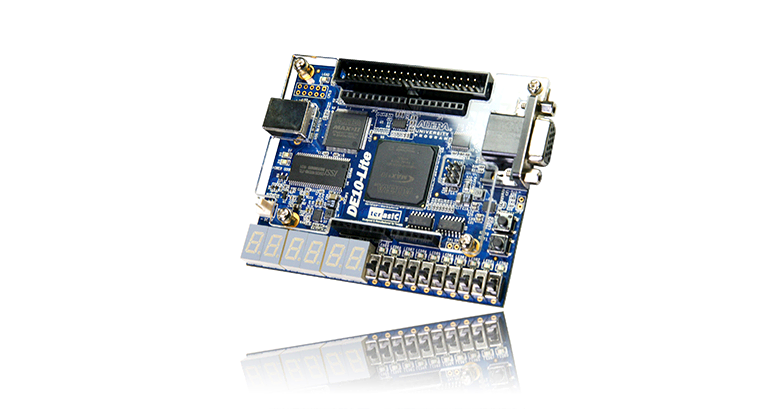
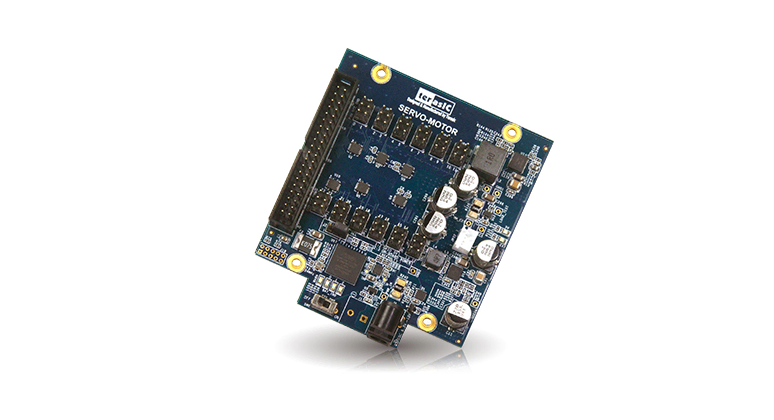
The "Servo Motor Kit" is an FPGA development kit manufactured by Terasic. By connecting it to the "DE10 Lite" equipped with Altera® FPGA's latest device, MAX® 10, you can immediately evaluate servo motor control.
The "Servo Motor Kit" can connect up to 24 servo motors and control them simultaneously.
It also comes with a reference design required for servo motor control, so after confirming operation, you can start development immediately based on this reference design.
The development kit also comes with circuit diagrams and a parts list, so you can easily design your board by referring to these diagrams and lists.
Development tools are free to use
The FPGA included in this development kit, "DE10 Lite," can be developed using Altera®'s free development software, "Quartus Prime Lite Edition."
In addition, the development kit is equipped with dedicated circuits for debugging and program writing, so development can be performed simply by connecting the development kit to a PC with the included USB cable.
Application example
- FA robot
- machine tools
- actuator
Details of the development kit "DE10 Lite" "Servo Motor Kit"
FPGA Development Kit "DE10 Lite"
| Manufacture name | Terasic |
| Type name | P0466 / DE10 Lite |
| Onboard FPGA |
|
| Memory device | 64MB SDRAM, x16 bits data bus |
| Expansion Connectors |
|
| Display | 4-bit Resistor VGA |
| Switches/Buttons/ LEDs/7-Segment Display |
|
| Accessories list |
|
Daughter card "Servo Motor Kit"
| Manufacture name | Terasic |
| Type name | P0288 / Servo Motor Kit |
| detail of function |
|
| Attached servo motor |
|
| Accessories list |
|
Click here to purchase products
Manufacturer site/Other related links
Details of DE10-Lite Board
Details of the Servo Motor Kit
Learn more about MAX 10 FPGAs