Introduction
Nice to meet you!
I'm Fai, a new engineer in 2017.
I'm a novice when it comes to electrical circuits, as I've studied machines first in college.
In this blog, I will explain the whys and whys of electric and electronic circuits that I wonder about in my daily work.
I would like to introduce myself to everyone after understanding myself.
Thank you very much.
This time, I will introduce the questions that I felt during the technical training.
At the beginning of the technical training, I studied about "parts".
Components are mainly classified into two types: “passive components” and “active components”.
Then I thought.
"Why do we have to separate them into two categories, 'passive components' and 'active components'?"
About the type of parts
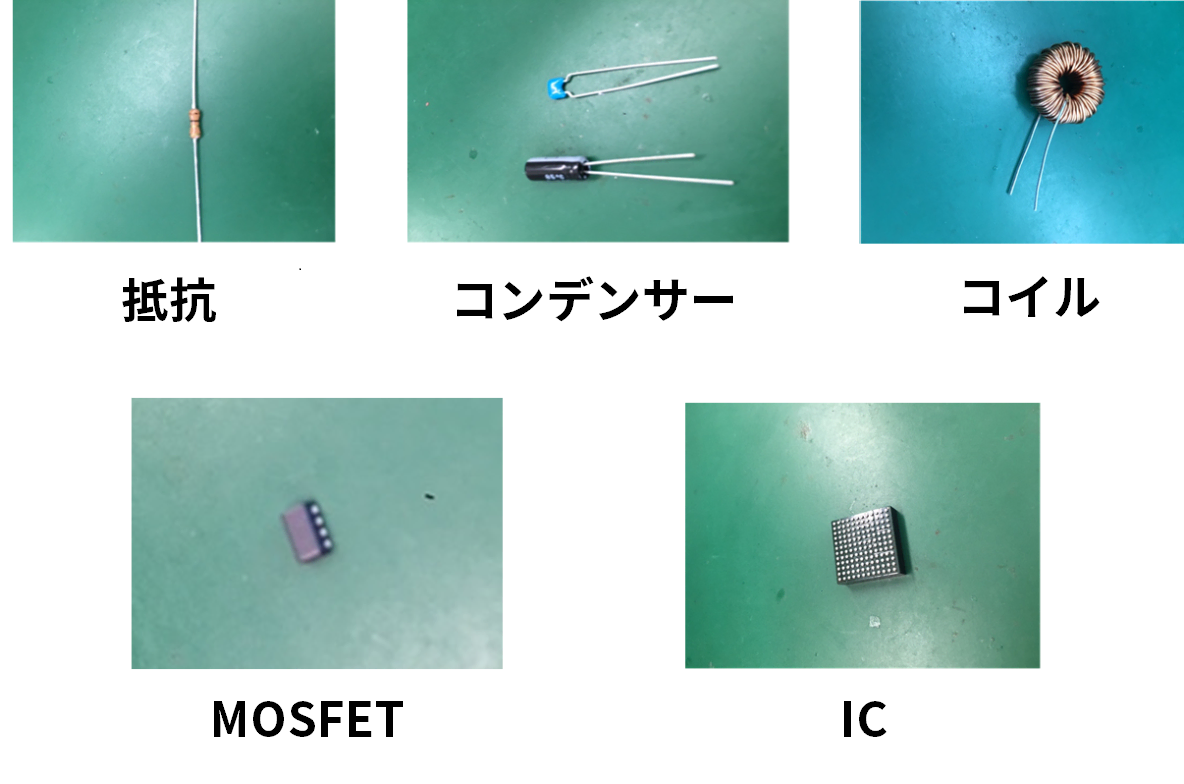
Have you ever seen something like this?
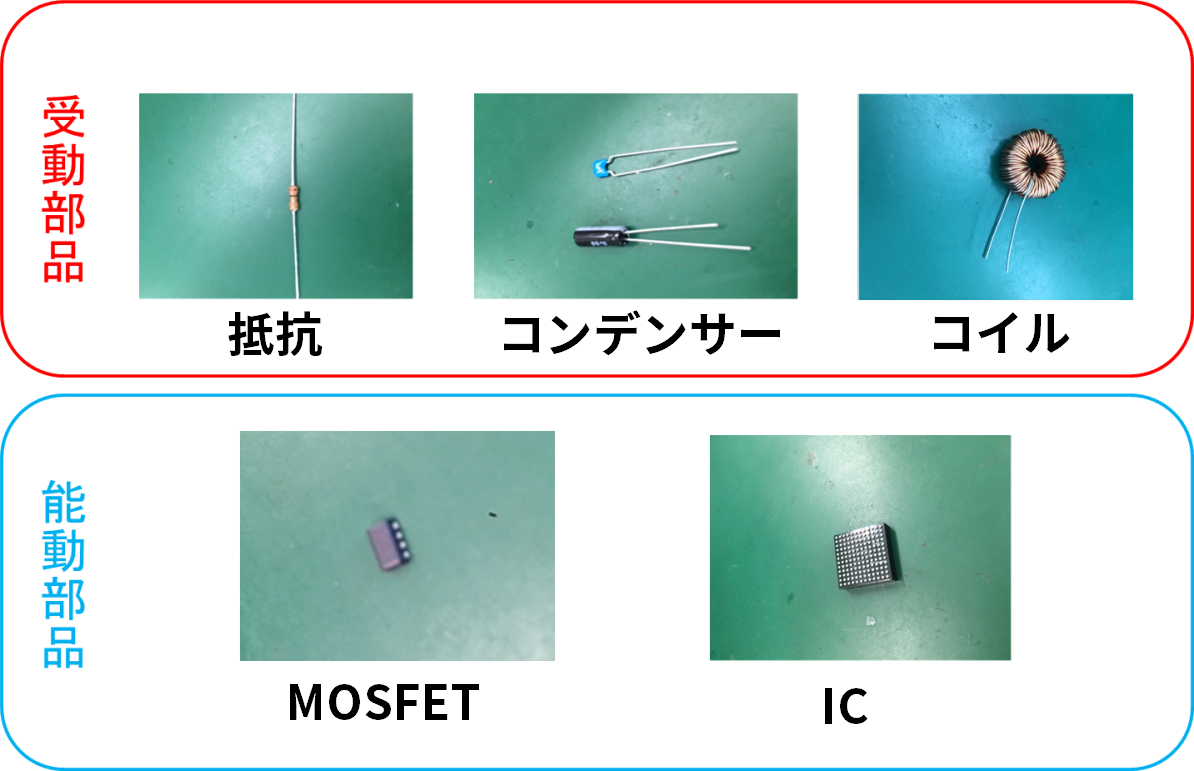
These are electronic circuit components, which can be divided into "passive components" and "active components" according to their behavior.
By the way, if these parts are separated, it will be as shown in Fig. 2.
Next, we will discuss the operation of passive and active components.
About passive components
Passive components are components that receive, consume, or emit energy from the outside.
Typical examples are resistors, capacitors, and coils.
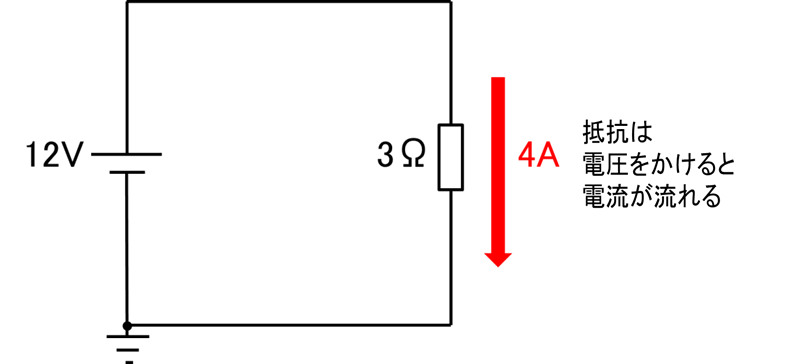
For example, if a resistor is applied with an external voltage as shown in the figure below, it consumes power and limits the current to a constant value.
In this way, resistors have the function of suppressing current by receiving and consuming power from the outside.
About active components
Active components are components that can amplify and rectify energy given from the outside.
Examples include bipolar transistors, FETs, and ICs.
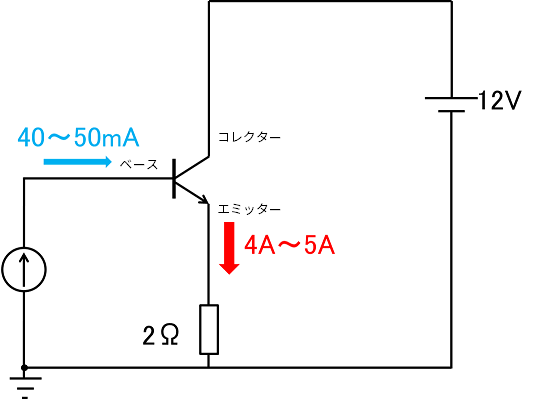
For example, a bipolar transistor
As shown in Fig. 4, the amount of current that is hfe times the current flowing through the base is passed between the collector and the emitter.
(This time hfe is 100)
In this way, the bipolar transistor can amplify the current by itself.
Compare the two schematics
Knowing the above two characteristics, I got the following impression.
Active parts: The "protagonist" that actively moves electricity
Passive components: "supporting parts" that simply receive and pass electricity
However, if you compare the two circuits, both contain passive components.
In this way, a circuit cannot be built with only active components, and passive components (resistors) play an important role in passing current.
Also, I thought that passive components played a supporting role, but I learned that they actually play an important role!
I look forward to hearing about the important role you play next time.
Summary
I learned that they can be divided into "passive components" and "active components" based on the difference in behavior of each component.
I also learned that active components shine only when passive components support them.
From now on, I would like to play an important role in the company like a passive component, and shine like an active component.
Until the end Thank you for reading!
Next time we look forward to!