- Semiconductor BusinessHOME
- Products and Services of Macnica,Inc.
-
technical information

-
Events and Seminars
- Handling Manufacturer
- Support
- Inquiry
- Click here to purchase products
- Semiconductor business e-mail magazine registration


 Narrow down by specifying conditions
現在2240件がヒットしています。check

Evolution of SiC semiconductors
The goal of every new generation of semiconductor switch technology is "faster" and SiC semiconductors are no exception. Next generation wide bandgap technology promises further improvements in efficiency, size and cost in many application areas.
"Generation" has had different meanings throughout history. In 1965, rock band The Who spoke of "my generation," shocking the establishment with their radical music and outrageous behavior. But technology wasn't changing at the same rate. The transistor was invented a generation earlier, in 1945, but it took another five years for the pocket calculator to appear and another 15 years for Motorola to sell the first "cell phone."
Today, technology "generations" are changing rapidly. 5G is already a reality, and 6G development has already begun. This was over two years ago. Semiconductor power switches are no different, with wide bandgap devices being developed primarily around SiC and GaN. SiC has leapt from its commercial beginnings six years ago to its third generation today, and is expected to achieve price parity with Si switches, especially when considering the knock-on benefits. For example, the latest cascode ultrafast normally-off SiC cascode JFETs are just as easy to drive and use as IGBTs and Si-MOSFETs, but with dramatically improved speed and much lower static and dynamic losses. ON Semiconductor's devices now have class-leading on-resistances of less than 9mΩ for 1200V devices and less than 7mΩ for 650V versions, and new packages such as the DFN8x8 have been introduced to take advantage of SiC performance with lower internal inductance and thermal resistance.

ON Semiconductor's 1200V and 650V Gen 3 devices have class-leading on-resistance values
The advantage of SiC was evident from the beginning, as it had a wider bandgap, which improved breakdown voltage and temperature rating. Even better is the "Rds.A" figure, which is 2.5 times better than Si-MOSFETs in the same voltage class and 13 times better than IGBTs. The rate is ten times that of silicon.
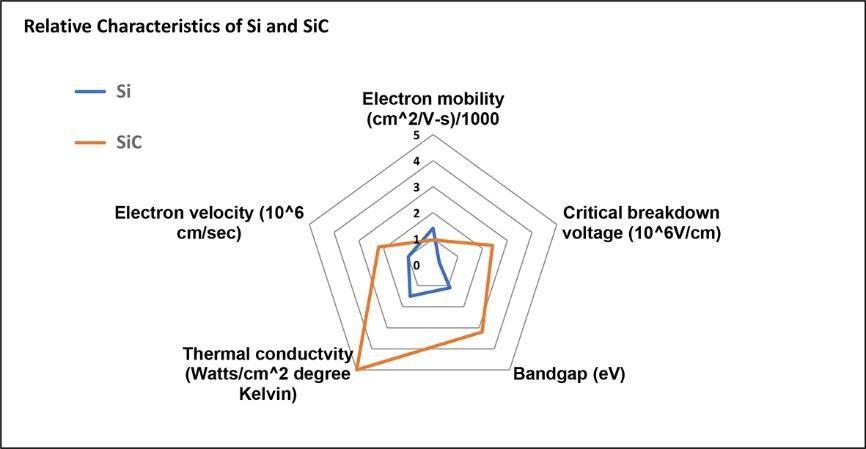
This opens up a wide range of applications for SiC semiconductors, including in space-constrained and energy-conscious sectors like 5G and data centers, where low losses drive, and in electric vehicles, where improved efficiency in traction inverters reduces heat sink size and cost, improving the range of the car. But SiC cascode JFETs also have ideal properties for other applications, such as solid-state circuit breakers, circuit protection and even linear operation for home and commercial applications. Target sectors range from aerospace, IT, industrial, domestic and renewable energy, where cooling is not an option but efficiency is required, and cost, size and environmental impact must be reduced.
But SiC semiconductors are just at the beginning of the evolution curve - how far can they go? While system engineers eagerly await investigation, we can make some predictions, based on how the evolution of SiC semiconductors so far has resembled that of previous Si devices.
Cell designs become more sophisticated with further improvements in Rds, the figure of merit i.e. smaller die means faster switching and lower on-resistance. Reducing die size results in smaller device capacitance, which means less energy lost during switching and lower gate drive losses. Voltage ratings increase to 1700V and above, leading to increased use of "stacked cascodes" which can be rated at several kV. Leadless devices become more common as current ratings increase and reach the limits of traditional bonded lead packages.
And leadless packages allow for higher switching frequencies. However, the TO-247 3- and 4-lead packages can still be used as drop-in replacements for IGBTs and Si-MOSFETs in legacy designs. As the technology matures, reliability is increasingly demonstrated, yields improve, and die sizes shrink, so costs can be expected to decrease.
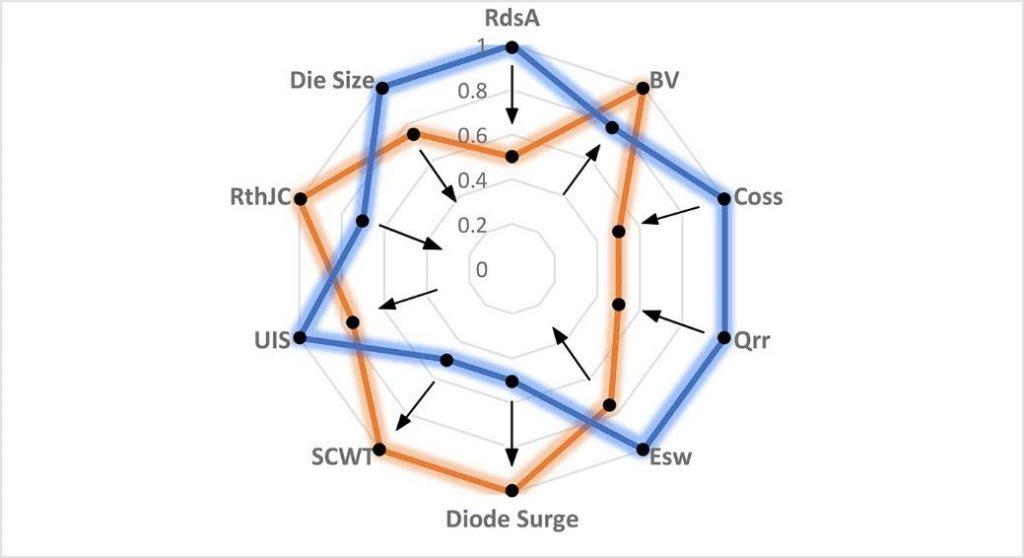
As SiC semiconductor technology advances, challenges await - for example, wafers need to be thicker to handle higher processing temperatures, which increases costs - but ONSemi has a roadmap and has even released its fourth generation of SiC cascode JFET devices.
Inquiry
If you have any questions regarding this article, please contact us below.
On Semiconductor Manufacturer Information Top Page
If you would like to return to the ON Semiconductor manufacturer information top page, please click below.