- Semiconductor BusinessHOME
- Products and Services of Macnica,Inc.
-
technical information

-
Events and Seminars
- Handling Manufacturer
- Support
- Inquiry
- Click here to purchase products
- Semiconductor business e-mail magazine registration


 Narrow down by specifying conditions
現在2240件がヒットしています。check
![[Good luck Tanepens ~ Support diary for young analog FAEs ~] Part 2: Techniques for improving ADC resolution](https://data.wovn.io/ImageValue/production/6304bcec88c8da6807e06765/en/a9b037069286e8e76d0fde864aa7174c/%E3%83%9E%E3%82%AF%E3%83%8B%E3%82%AB_fv_2%E8%A9%B1_1024px_353px_%E5%A4%96%E5%9B%BD%E8%AA%9E_english.jpg)
![[Good luck Tanepens ~ Support diary for young analog FAEs ~] Part 2: Techniques for improving ADC resolution](https://data.wovn.io/ImageValue/production/6304bcec88c8da6807e06765/en/0a70f2896aa7fa476ac52d662d05aced/en_149077_adi_article_pic1.png)
![[Good luck Tanepens ~ Support diary for young analog FAEs ~] Part 2: Techniques for improving ADC resolution](https://data.wovn.io/ImageValue/production/6304bcec88c8da6807e06765/en/b2bdc761584c745c430ce23817c63079/en_149077_adi_article_pic2.png)
I joined Macnica as a new graduate and am currently working as a junior semiconductor FAE.
I originally joined the company from a completely different field, so I had a lot of trouble catching up on knowledge in the analog field. In particular, when proposing AD converters, which are analog components, I struggled with how to consider the accuracy of the AD converters I was introducing for the customer's application.
This time, as the second installment, I would like to introduce "oversampling," a technique for improving resolution that is necessary when considering the accuracy of AD converters.
Review of AD converter resolution
Before we get into the main topic of this article, we first need to understand the concept of AD converter resolution. When I first started working with customers, I assumed that the resolution value in the header of an AD converter 's datasheet defined the accuracy of that AD converter.
However, I learned that in reality, AD converters generate noise, which can reduce the effective resolution. In such cases, the concepts of effective resolution and noise-free resolution become necessary.
The effective resolution is expressed by the RMS noise of the AD converter and the full-scale input voltage of the AD converter as shown in the following formula.
Effective resolution
full-scale input voltage range
ADC RMS noise: ADC RMS noise
The noise-free resolution is expressed by the peak-to-peak noise of the AD converter and the full-scale input voltage of the AD converter as shown in the following formula:
Noise-free resolution
full-scale input voltage range
ADC peak-to-peak noise
More details can be found in our previous article.
There is also the concept of ENOB (Effective Number Of Bits) when considering the resolution of an AD converter. ENOB is often confused with effective resolution, but it is important to remember that they are different things. Effective resolution and noise-free resolution basically measure the noise performance of an AD converter at DC, but ENOB also takes into account the noise of the AD converter at AC.
The measurement method typically involves FFT analysis of a sine wave input to an AD converter, and is defined as follows in IEEE® Standard 1057:
full-scale input voltage range
ADC RMS noise: ADC RMS noise
When considering ENOB, we also need to consider an index called SINAD (Signal to Noise and Distortion Ratio). SINAD is defined as the ratio of signal to noise plus distortion, and can be expressed as follows:
RMS input voltage: RMS input voltage
RMS noise voltage: RMS noise voltage
Since ENOB corresponds to the resolution that takes into account both noise and distortion, it can also be generally expressed using SINAD as follows:
After learning about the effective resolution and ENOB concepts of AD converters, I began to carefully read datasheets when selecting products, but when I actually did the calculations, I found that the resolution of the AD converter was lower than I expected, which made it difficult to select a product.
At that time, a senior FAE told me, "Oversampling will increase resolution," which taught me something new.
I didn't know there was a method to increase resolution until I heard this comment from my senior. In this article, I would like to introduce "oversampling," a method of improving resolution that I learned on my own after hearing this comment from my senior.
About Nyquist's theorem
One way to improve the resolution of an AD converter is through a technique called "oversampling," but in order to understand this concept, it is necessary to understand the Nyquist theorem.
The Nyquist theorem states that an AD converter will lose information from the original input signal unless it samples at a frequency at least twice the maximum frequency contained in the input signal. In other words, the sampling frequency must be at least twice the maximum frequency of the input signal. In this case, 1/2fs, which is half the sampling frequency fs, is called the Nyquist frequency. If the sampling frequency is less than twice this Nyquist frequency, a phenomenon called "aliasing" will occur, which will cause errors.
For example, when sampling a sinusoidal signal of a single frequency fa, if the sampling frequency fs is slightly higher than fa but lower than 2fa (fa < fs < 2fa), it does not satisfy the requirement of twice the Nyquist frequency, and an alias (a low-frequency signal that does not actually exist) of fs-fa occurs. In the example in Figure 1, the sampling corresponds to both the input signal fa and the alias fs-fa, and the sampled data makes it impossible to distinguish whether the original signal frequency is fa or fs-fa.
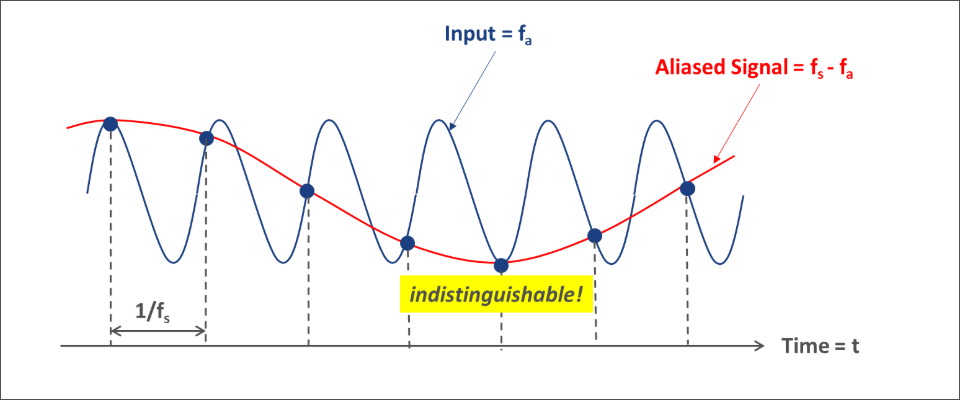
When considering the sampling frequency of an AD converter, it is necessary to ensure that it is twice the Nyquist frequency.
About oversampling
This article introduces "oversampling," one method for improving the resolution of an AD converter. Oversampling is a technique for sampling at a much higher frequency than the Nyquist frequency of 1/2fs mentioned above. It is generally said that oversampling at four times the speed improves the resolution of an AD converter by one bit.
For example, consider an AD converter with N-bit resolution without oversampling. If an input signal with a single frequency of 100 Hz is sampled at twice the Nyquist frequency (2 × 100 Hz = 200 Hz), it is possible to obtain a digital output with an ENOB specific to the AD converter.
On the other hand, if oversampling is performed with an oversampling ratio of k=4, the sampling rate will be 800Hz. In this case, the quantization noise of the data obtained by oversampling is distributed over a wide frequency band, and the SNR is improved by removing unnecessary high frequency components with a digital filter.
In this case, the improved SNR can be estimated using the AD converter resolution N from the following equation:
where k = fs / 2 × fin, where fin is the input signal frequency.
Using this formula, we can calculate the oversampling factor to increase the resolution. SNR can be expressed as SNR(dB) = 6.02 × N + 1.76, so if you want to increase 1 bit from an AD converter with 16-bit resolution, for example, The SNR of a 17-bit AD converter is calculated as follows:
Next, the oversampling factor is calculated from the calculated SNR using the formula mentioned above.
From the above, we can see that in order to improve the resolution by 1 bit, the oversampling factor must be 4 or more.
The resolution improvement for various oversampling factors is as follows (Table 1):
|
Oversampling Factor |
Improved resolution |
|
2 |
0.5 |
|
4 |
1 |
|
8 |
1.5 |
|
16 |
2 |
|
32 |
2.5 |
Table 1: Example of increased resolution versus oversampling ratio
Summary
As mentioned above, when considering the resolution of an AD converter, it is necessary to consider the number of bits that will actually be effective depending on the application requirements. Care must be taken when setting the AD converter 's sampling rate, as this is a parameter that determines the resolution. Oversampling is one method of increasing the resolution of an AD converter, and is an effective data processing technique for obtaining accurate conversion values from an AD converter.
Good luck Tanepens ~Support diary for young analog FAEs~ Article list
・ Part 1: How do you think about ADC resolution?
Part 2: Techniques for improving ADC resolution
・ Regarding the third session, I stated that it could accept ±40V input, but...
Inquiry
If you have any questions regarding this article, please contact us below.
Analog Devices Manufacturer Information Top
Analog Devices Manufacturer Information If you would like to return to the top page, please click below.