- Semiconductor BusinessHOME
- Products and Services of Macnica,Inc.
-
technical information

-
Events and Seminars
- Handling Manufacturer
- Support
- Inquiry
- Click here to purchase products
- Semiconductor business e-mail magazine registration


 Narrow down by specifying conditions
現在2189件がヒットしています。check
![[Good luck Tanepens - A support diary for young analog FAEs] Part 1: How do you think about ADC resolution?](https://data.wovn.io/ImageValue/production/6304bcec88c8da6807e06765/en/d6b06bd2d69b60c6352cd0359f4e34df/%E3%83%9E%E3%82%AF%E3%83%8B%E3%82%AB_fv_1%E8%A9%B1_1024px_353px_english-%281%29.jpg)
![[Good luck Tanepens - A support diary for young analog FAEs] Part 1: How do you think about ADC resolution?](https://data.wovn.io/ImageValue/production/6304bcec88c8da6807e06765/en/2f6443f5fb4d8fab865c7035a246a31d/en_148105_adi_article_pic1.png)
![[Good luck Tanepens - A support diary for young analog FAEs] Part 1: How do you think about ADC resolution?](https://data.wovn.io/ImageValue/production/6304bcec88c8da6807e06765/en/b6dd7a55376d9258a864bd0312dced9d/en_148105_adi_article_pic2-%281%29.png)
Nice to meet you. I joined Macnica as a new graduate and am currently working as a junior semiconductor FAE.
I originally joined the company from a completely different field, so I had a lot of trouble catching up on knowledge in the analog field. In particular, when proposing AD converters, which are analog components, I struggled with how to consider the accuracy of the AD converters I was introducing for the customer's application.
This time, I would like to introduce how to think about specifications related to resolution, which are necessary when considering the accuracy of AD converters.
Resolution Pitfalls
When selecting an AD converter, the first thing you will be concerned about is its accuracy. When you open the datasheet, your eyes will probably first be drawn to the resolution value specified on the cover, but there is a pitfall there.
After I finished my training and started working with a customer, I received a request during a meeting from the customer to recommend a high-precision AD converter with a resolution of 24 bits or more. I introduced a 24-bit AD converter product, but as soon as the customer looked at the datasheet, he began to do some calculations right in front of me.
The customer replied, "It's not bad, but I'd like a little more."
At first, I didn't understand what he was talking about because I thought the resolution listed as a spec summary on the cover of the data sheet was sufficient to meet my requirements. However, I was naive, and in reality I had to take into account things like "effective resolution" and "noise-free resolution."
In reality, AD converters generate a certain amount of noise. This noise mainly consists of noise inherent to the AD converter and quantization noise that occurs during conversion, but this noise affects the actual resolution of the AD converter.
Therefore, when considering the resolution of an ADC, it is necessary to take into account the concepts of "effective resolution" and "noise-free resolution" according to the specifications.
RMS noise and peak-to-peak noise
Before we get into the concepts of "effective resolution" and "noise-free resolution," let's first discuss two concepts of noise: RMS noise and peak-to-peak noise.
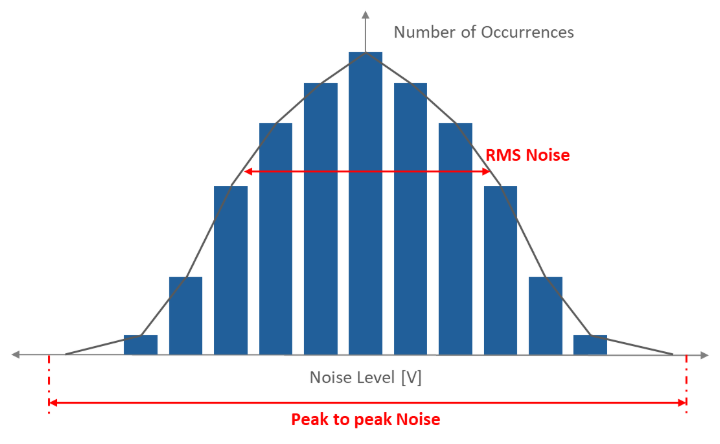
There are two main ways to express the random noise contained in the analog values of an AD converter: RMS noise and peak-to-peak noise.
The probability distribution of noise by magnitude is generally represented by a Gaussian distribution as shown in Figure 2, and RMS noise is the effective value of the standard deviation calculated from the Gaussian distribution in Figure 2. Of these, RMS noise accounts for more than 99.9 % of the probability of a Gaussian distribution, while peak-to-peak noise appears with a probability of approximately 0.1 % of the probability of a Gaussian distribution, and can be expressed as RMS noise x 6.6.
Effective resolution
The effective resolution is expressed as follows using the RMS noise of the AD converter and the full-scale input voltage of the AD converter:
Effective resolution
full-scale input voltage range
ADC RMS noise: ADC RMS noise
For example, let's calculate the effective resolution using Analog Devices' 24-bit AD converter, theAD7124-4. The full-scale input voltage range of an AD converter is calculated based on the AD converter's reference voltage. If a PGA is built in, its gain must also be taken into account.
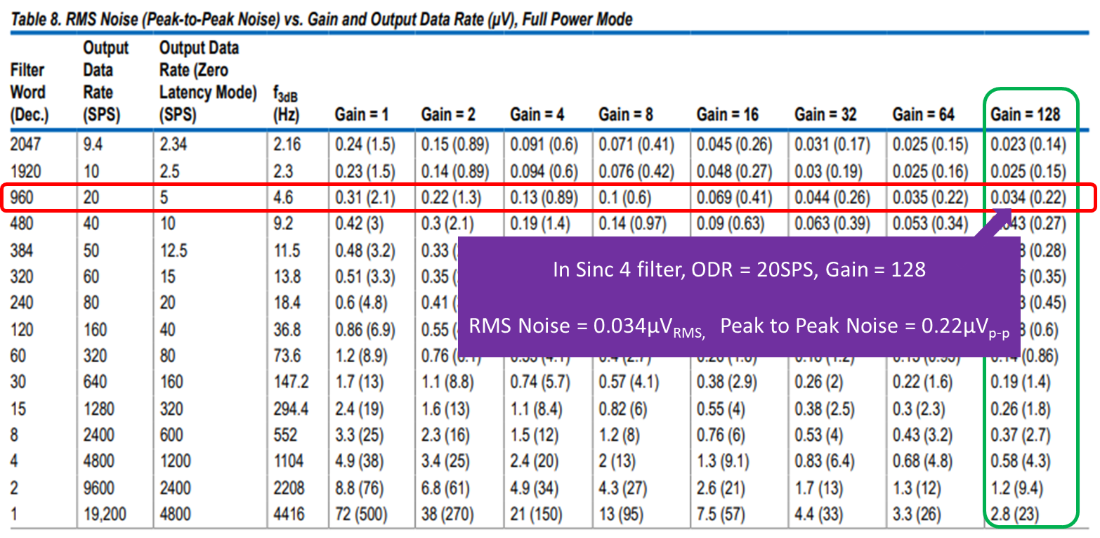
Considering the conditions (Figure 3) using a Sinc4 filter, a sampling rate of 20 SPS, a gain setting of 128, and a reference voltage of 2.5 V, the datasheet states that the noise generated is 0.034 μV RMS over the input range of (±VREF/PGA = ±2.5V/128 = 39.1 mV).
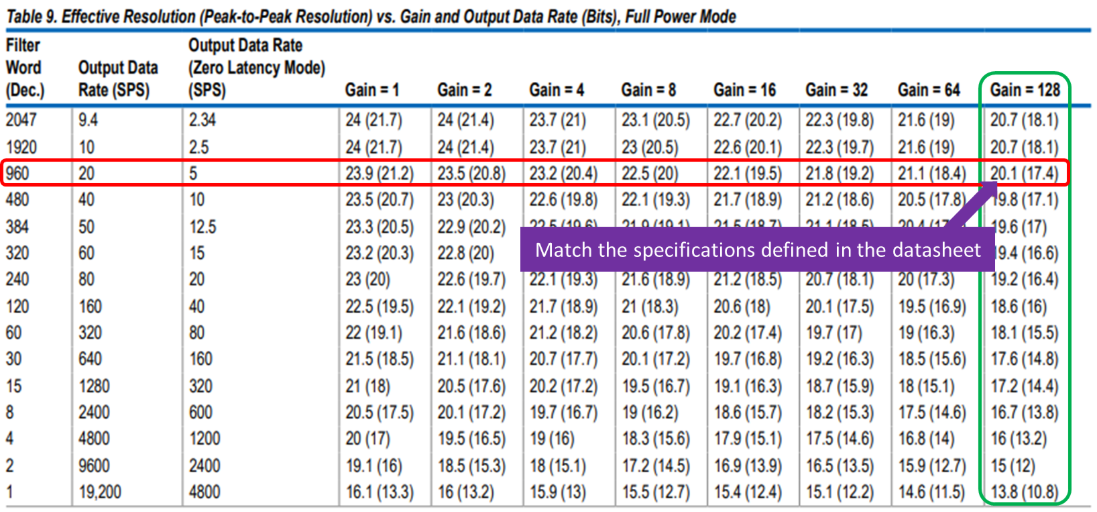
Therefore, the effective resolution can be calculated as follows: It can also be confirmed that this is consistent with the noise-free resolution specified in the datasheet (Figure 4).
In this way, even for products released as 24-bit products, when you calculate the effective resolution taking RMS noise into account, the resolution may be smaller than 24-bit.
Therefore, when selecting an AD converter, it is important to understand the resolution required for the actual application.
Next, we will look at noise-free resolution.
Noise-free resolution
Noise-free resolution differs from effective resolution in that it uses peak-to-peak voltage noise rather than RMS noise when calculating noise. Noise-free resolution is also expressed in bits and is defined as follows:
Noise-free resolution
full-scale input voltage range
ADC peak-to-peak noise
Let's also look at noise-free resolution using the Analog Devices 24-bit AD converter "AD7124-4"as an example. If we consider the conditions (Figure 3) of using a Sinc4 filter, a sampling rate of 20 SPS, a gain setting of 128, and a reference voltage of 2.5 V, the datasheet shows that a noise of 0.22 μVp-p will be generated within the input range of (±VREF/PGA = ±2.5V/128 = 39.1 mV).
Therefore, the noise-free resolution can be calculated as follows: It can also be confirmed that this is consistent with the noise-free resolution specified in the datasheet (Figure 4).
As you can see, the noise-free resolution is calculated to be approximately 2.7 bits smaller than the effective resolution. This is because the noise-free resolution takes into account peak-to-peak noise. From the Gaussian distribution described above, peak-to-peak noise is 6.6 times the RMS noise. Therefore, the noise-free resolution is estimated to be smaller than the effective resolution.
However, peak-to-peak noise can cause the AD converter's code to flicker. Therefore, a more representative resolution that eliminates the flickering bits is called noise-free resolution. Therefore, when considering the accuracy of an AD converter, the concepts of effective resolution and noise-free resolution are very important.
Summary
As mentioned above, when considering the resolution of an AD converter, it is necessary to estimate the number of bits that will actually be available depending on the requirements of the application.
There are two ways to think about the number of effective bits: effective resolution and noise-free resolution. The method for calculating the effective number of bits may differ depending on the manufacturer, so when comparing products from different manufacturers, be sure to check which method is used to specify it. Therefore, when selecting an AD converter, it is very important to understand the concepts of effective resolution and noise-free resolution in order to estimate the true accuracy of the device.
Good luck Tanepens ~Support diary for young analog FAEs~ Article list
・Part 1: How do you think about ADC resolution?
・ Part 2: Techniques for improving ADC resolution
・ Regarding the third session, I stated that it could accept ±40V input, but...
Inquiry
If you have any questions regarding this article, please contact us below.
Analog Devices Manufacturer Information Top
Analog Devices Manufacturer Information If you would like to return to the top page, please click below.